



sales@pj-led.com
0086-13925312260
If you are a lighting contractor or designer specifying commercial LED panel lights, you’ve likely faced this question: Should you choose an LED edge lit panel or a traditional back lit panel?
While both provide even, shadow-free illumination, they are engineered completely differently. Choosing the wrong one can lead to aesthetic compromises, higher energy bills, or maintenance headaches.
Here is a deep dive into the differences between edge lit and backlit panels, covering everything from structure to long-term costs.
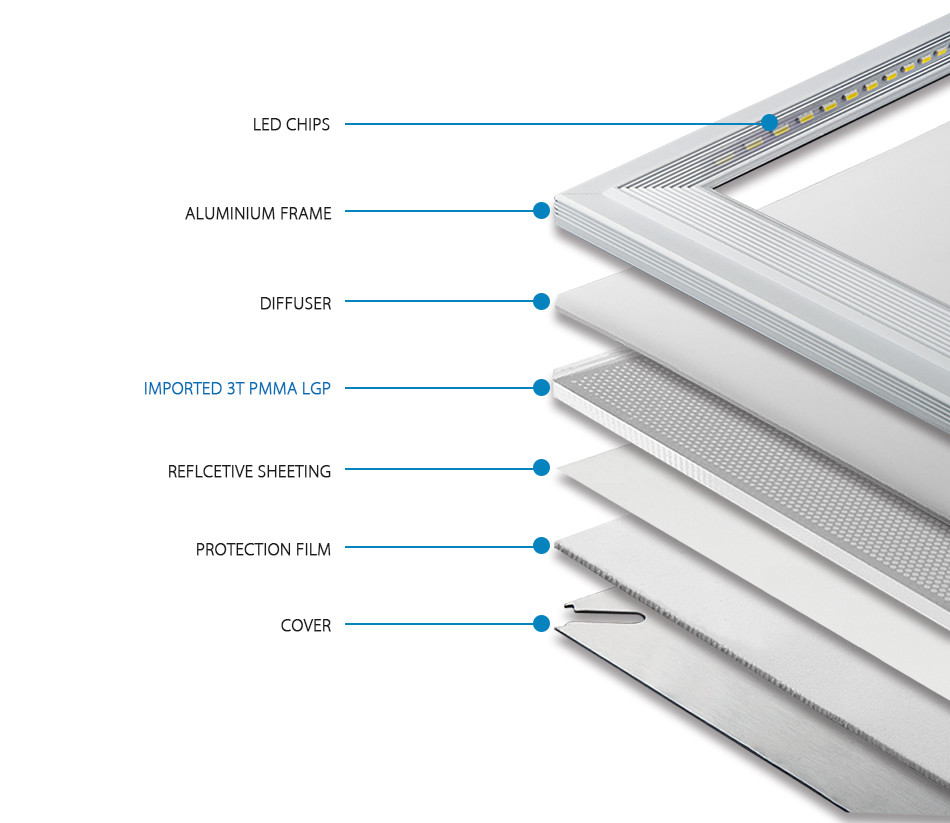
LED Edge Lit Panel: Uses a Light Guide Plate (LGP) to distribute light from LEDs positioned on the edges. This allows for an ultra-thin profile, typically 9mm to 12mm. It blends seamlessly into modern drop ceilings and makes low-ceiling spaces feel more spacious.
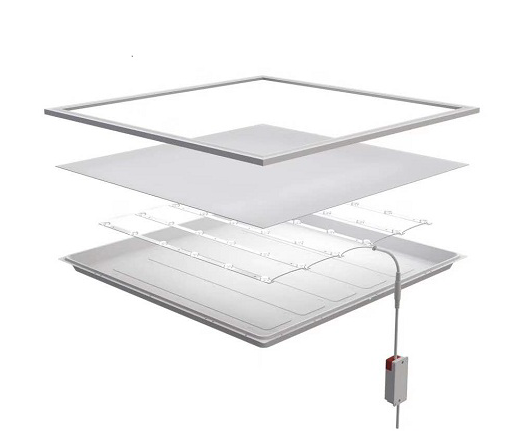
Back Lit Panel: Uses LEDs arranged directly behind a diffuser. Because of the depth needed to mix the light properly, these panels are thicker, usually 25mm to 35mm.
LED Edge Lit Panel Structure picture:
Back Lit Panel Structure Picture:
Winner: Edge-lit (for aesthetics and tight spaces).
LED Edge Lit Panel: Light bounces multiple times inside the LGP, resulting in very soft, uniform light with minimal glare. However, the light transmission loss means efficacy is usually around 90–110 lm/W.
Back Lit Panel: LEDs shoot light directly downward, offering higher light transmission. High-quality backlit panels can easily achieve 120–140 lm/W, making them more energy-efficient and suitable for high-lux environments.
Winner: Back-lit (for raw energy efficiency and brightness).
LED Edge Lit Panel: The LEDs are densely packed along the frame. Heat is concentrated in a small area, making thermal management a critical challenge. Cheap edge-lit panels often suffer from yellowing LGP or rapid lumen depreciation.
Back Lit Panel: LEDs are spread evenly across the entire back plate. This larger surface area dissipates heat much more effectively, generally resulting in a longer and more stable lifespan.
Winner: Back-lit (for durability and thermal stability).
LED Edge Lit Panel: The Light Guide Plate (usually PMMA) is expensive, making the upfront unit cost higher. Installation is straightforward due to the lightweight, ultra-thin design.
Back Lit Panel: The manufacturing cost is generally lower because it uses simpler optical structures. However, the heavier weight might require more secure ceiling mounting.
After-Sales: Edge-lit panels are mostly fully sealed (non-replaceable parts). Back-lit panels sometimes allow for replacing the LED strips, though in modern projects, both are usually replaced entirely if they fail.
Winner: Back-lit (for initial cost); Edge-lit (for lightweight installation).
| Feature | LED Edge Lit Panel | Back Lit Panel |
|---|---|---|
| Thickness | Ultra-thin (9-12mm) | Standard (25-35mm) |
| Light Efficacy | 90-110 lm/W | 120-140 lm/W |
| Visual Comfort | Very soft, low glare | Depends on the diffuser (prismatic) |
| Heat Dissipation | Concentrated (edge) | Excellent (full back) |
| Aesthetic | High-end, minimalist | Standard, functional |
| Best For | Offices, hotels, low ceilings, retail | Supermarkets, schools, factories |
Choose an LED Edge Lit Panel if:
You prioritize a sleek, ultra-thin appearance, have lower ceiling heights, and are designing for premium commercial spaces where soft, glare-free light is essential.
Choose a Back Lit Panel if:
You need maximum energy efficiency, higher brightness, better heat management for long lifespan, and are working on large-scale projects (like warehouses or schools) where budget and performance are the top priorities.
Need help specifying the right panel for your project?
PJ-LED specializes in both ultra-thin LED edge lit panels and high-efficacy backlit panels. We supply SAA, ETL, and CE-certified solutions for global contractors.

Contact: Miss.Peng
Phone: 0086-13925312260
E-mail: sales@pj-led.com
Whatsapp:0086-13925312260
Add: 5F Block A No.14 North Zhi'An Road Jun'An Town Shunde Foshan Guangdong province